
One round of Plinko has one decision set and one outcome: you choose a bet, rows and a risk level, a ball drops, and you receive the bet times the multiplier of the slot where it lands. There is no skill step after the click. What you control is the size of the swings and how long the budget lasts.
The six moves of one round
Set the bet
Pick an amount in the bet field. A 200 MAD session at 10 MAD per drop is 20 balls.
Choose the rows
Classic BGaming boards offer 8 to 16. A board with n rows has n + 1 slots at the bottom.
Choose the risk level
Low, Normal (medium) or High. This changes how the multipliers spread, not the average return.
Drop the ball
One press, one ball, in manual mode. The result is drawn at once; the bouncing is animation.
Read the result
Payout is bet times multiplier. A x0.3 slot on 10 MAD pays 3 MAD, a x16 slot pays 160 MAD.
Decide: next ball or stop
Auto mode drops a series. Set the number of balls to what your budget allows before you start it.

Not every version follows this layout. Game catalogues describe Spribe's Plinko with 12, 14 or 16 rows and three ball colours instead of risk levels, and BGaming's Plinko XY with the same tables as the classic. Read the screen of the version you open before you press anything.
Rows and risk, one tab per level
Each tab shows the lowest and highest slot multiplier on the classic 16-row board, with the dirham range for a 10 MAD bet.
Range x0.5 to x16, so a 10 MAD bet returns between 5 MAD and 160 MAD. The centre is mild and the edges are modest. Balances move in small steps, which suits a first session.
Range x0.3 to x110, so 10 MAD returns between 3 MAD and 1,100 MAD. The centre slots pay as little as x0.3, and the edge slots pay up to 110 times the bet. Expect uneven sessions.
Range x0.2 to x1000, so 10 MAD returns between 2 MAD and 10,000 MAD. The centre slots pay about a fifth of the bet and the top slot is a rarity, once in 65,536 drops on our ideal board. Long dry runs are normal.
Rows work in the same direction. With 8 rows, 93% of balls land within two slots of the centre on an ideal board, so results bunch up. With 16 rows the figure is 79% and the tails stretch out. That is our calculation, not a provider figure; the RTP page has the whole table.
How far 100, 200 and 300 MAD go
Divide the budget by the bet. At 5 MAD, 200 MAD buys 40 drops; at 10 MAD, 20 drops; at 20 MAD, only 10. At about 8 seconds per manual drop, our assumption, 40 drops take around five minutes. Enter your own numbers below.
Auto mode compresses this. Fifty balls at 10 MAD commit 500 MAD in about a minute, more than the whole budget of a normal evening. For how to size bets and set a stop point, read the strategy page.
Learn the controls
Run a few balls before you commit money
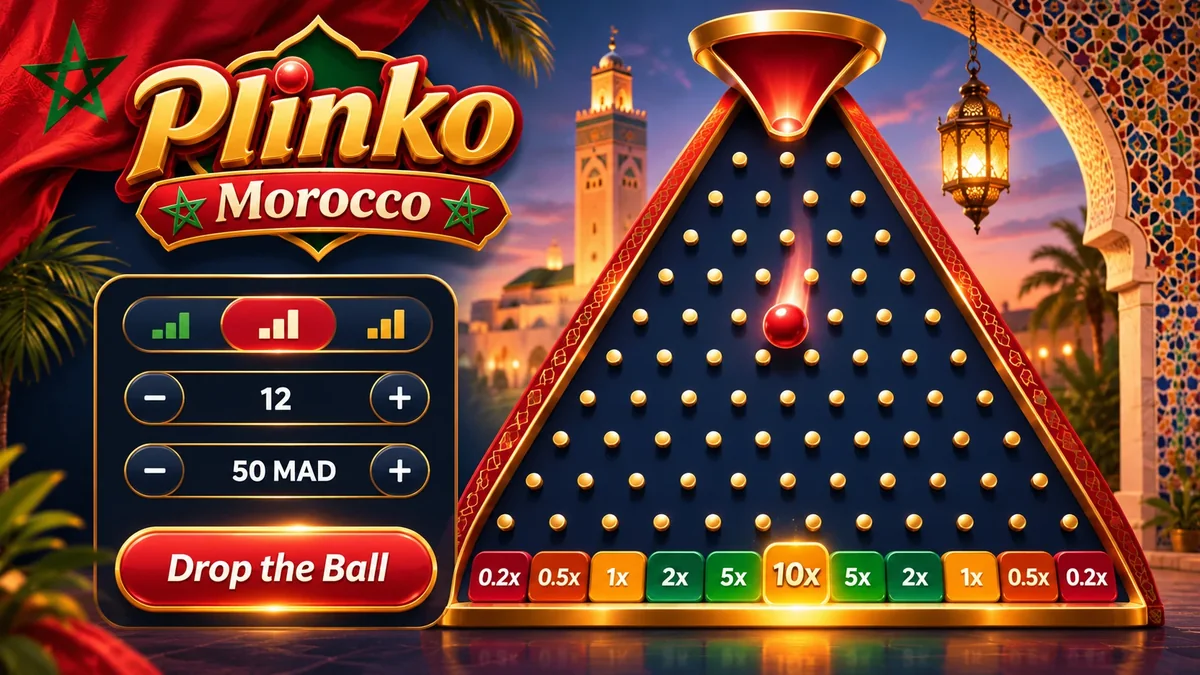
Open a Plinko game, change rows and risk, and watch how the multiplier table moves. 18+ only.
Before your first real drop
If you have not tried the board yet, the demo page has a 150-drop test plan. If you are ready for real money, choose the operator first.
With bet, rows and stop amount fixed, open Plinko and set them.
What no predictor or signal can tell you about the next ball